Secret protocols from the National Trade Register Office

One of the fundamental principles underlying the rule of law is that for a normative act to be enforceable, it must undergo a process of legal publicity.
Therefore, for the normative acts to come into force, they must be published either in the official monitor, in the local monitor, or in other repositories that ensure these acts can be consulted and potentially challenged in administrative litigation, thus guaranteeing jurisdictional control over these acts.
If a law is unconstitutional, you challenge it at the Constitutional Court.
If an administrative normative act is illegal/unconstitutional, you can challenge it in the administrative litigation court.
In order to challenge a normative act, regardless of its level, it should not be secret. And here we have a problem when it comes to the ONRC.
In Romania, there is still a huge confusion regarding the CAEN codes.
The CAEN codes represent the transposition of NACE statistical codes into the national economy, codes that serve reporting purposes and are necessary for registration with the ONRC so that the national statistics institute can perform its duties.
Thus, they have become, through practice, true mechanisms for classifying "regulated" activities from "unregulated" ones, although in essence, CAEN codes can include both regulated and unregulated activities under the same code.
This was consented to by law, with the entry into force of Law 265/2022, which modernizes the trade register.

Under the old law, a delegated judge ensured the legality of company registration through a non-contentious procedure, a role that has been replaced in the new law by an official with a quasi-jurisdictional function to oversee the prior legality of the registration.
He briefly verifies that you are allowed to establish your company, that you haven't included any inaccuracies in the articles of incorporation, and that you have followed the legal procedures required.
Among these procedures, there is also Article 121, paragraphs 3 and 4 of Law 265/2022, which transforms CAEN codes into tools for restricting the activities performed.
However, it is surprising that these restrictions are established not through administrative acts, but through mandatory norms for interpreting the law provided by the ONRC. mandatory standards for registrars that take precedence over the law.
ONRC has repeatedly refused to bring these administrative acts to my attention, claiming that they are of an internal nature, thus preventing me from legally contesting their validity in administrative litigation.
I have a document that generates obligations for me (to comply with certain checks/administrative procedures), but obligations that I cannot consult because the information regarding their existence and the invoked legal framework is internal.
According to Law 265/2055, the registrar cannot be subjected to any "restrictions" or "constraints" from any authority (implicitly including ONRC / the authorities with which ONRC has a protocol), effectively establishing this mechanism in Article 121 of the same law.

Thus, we find ourselves in a situation where a company is blocked from registration based on laws or legal articles that are not disclosed to the applicant seeking registration in the commercial register.
I made efforts to contact the ONRC, which were ignored (as I am not allowed to request internal documents), and then after I did pressures that led to the dismissal of the general director of ONRCto be taken seriously with promises (which clearly remained at the level of talk).
Previously, they vehemently refused to communicate the circulars/protocols to me.

Promise after the change of the ONRC director that they will communicate it to me, just a word left:

Since 2024, when they told me they would put something in place, they haven't done anything.
And so, I was not allowed to create invoicing software + automated processing of accounting documents and the preparation of preliminary calculations for accountants, because CECCAR made a secret protocol with ONRC, establishing that such activities fall exclusively under their jurisdiction.
The court has established that this activity conducted in the form of SaaS (specifically what keez.ro generates over one million euros annually) is exclusive to the profession of certified accountant or authorized accountant, a solution that is highly debatable in substance and procedurally questionable (on what basis do you determine the legality of an activity still at the planning stage?).
The fund is irrelevant here; the issue is with the procedure.
Immediately, I raised a constitutional exception that is now subject to constitutional review at the Constitutional Court.
Here’s what the Government says:


If I told you this (draft, it still needs work))


Of course, There must be a mechanism to verify the legality of certain companies, so that people do not start businesses selling weapons or medications without prior validation.
I believe it is a good omen that the internal normative acts prohibiting these activities are public, so they can be subject to judicial review (through the courts of administrative litigation).
Otherwise, we discuss an unauthorized delegation of legislative power from parliament to public and private institutions of public interest (e.g., CECCAR, the College of Physicians, the College of Psychologists, etc.) which sometimes find themselves in a conflict of interest that encourages them to interpret in their favor.
When the lawyers of a private legal entity decide what you are allowed or not allowed to do, and you cannot contest that, while public institutions are obliged to acknowledge what the director of ONRC negotiated with the director of this guild, it poses a problem to the rule of law.
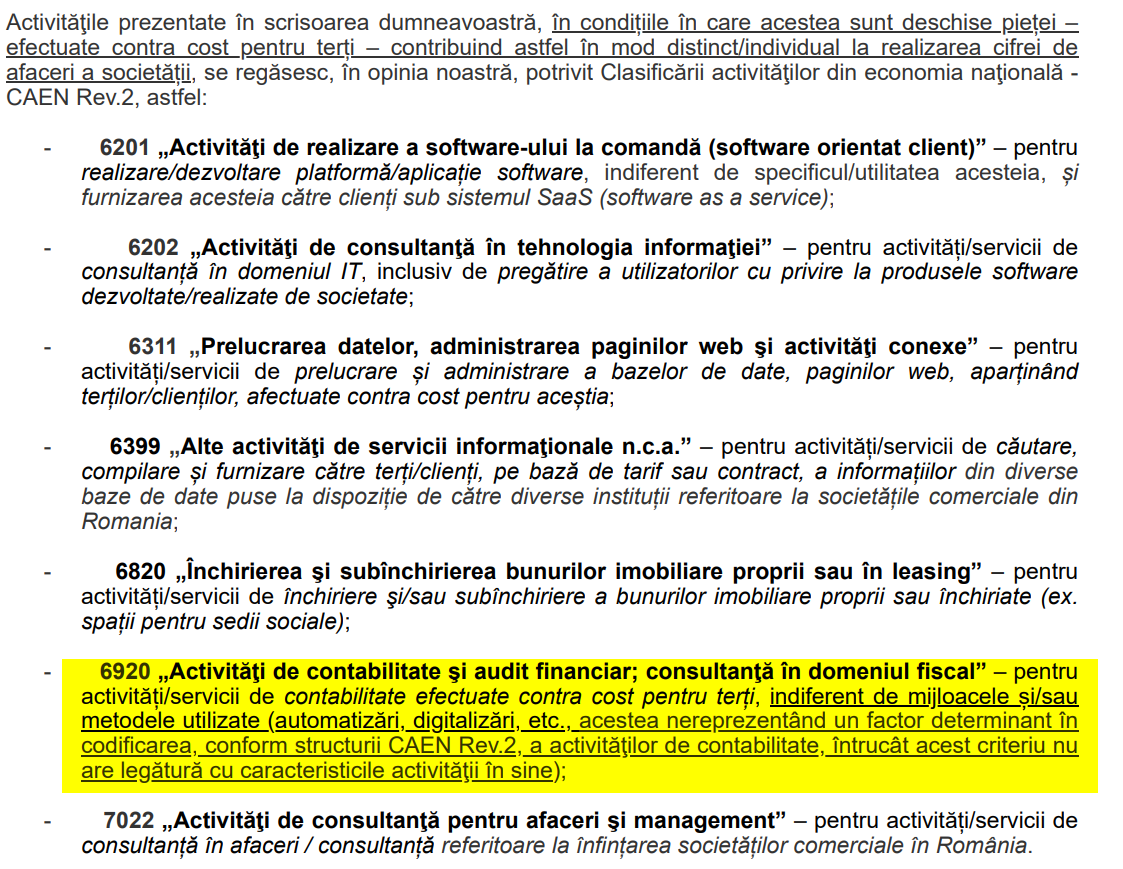
The solution cannot be what public lawyers recommend on Facebook, nor what my lawyers advised me on CAJ - namely, to falsely declare activities other than those actually conducted, by "creatively" interpreting my activity, even though INSSE specifically told me that my activity is accounting (6920).
We will see what the Constitutional Court decides. It's a night of madness, and I expect there will be some naysayers who say it's acceptable for secret protocols to create rights for third parties without public disclosure. I've had enough lawyers discuss this with me who support that it's okay.